
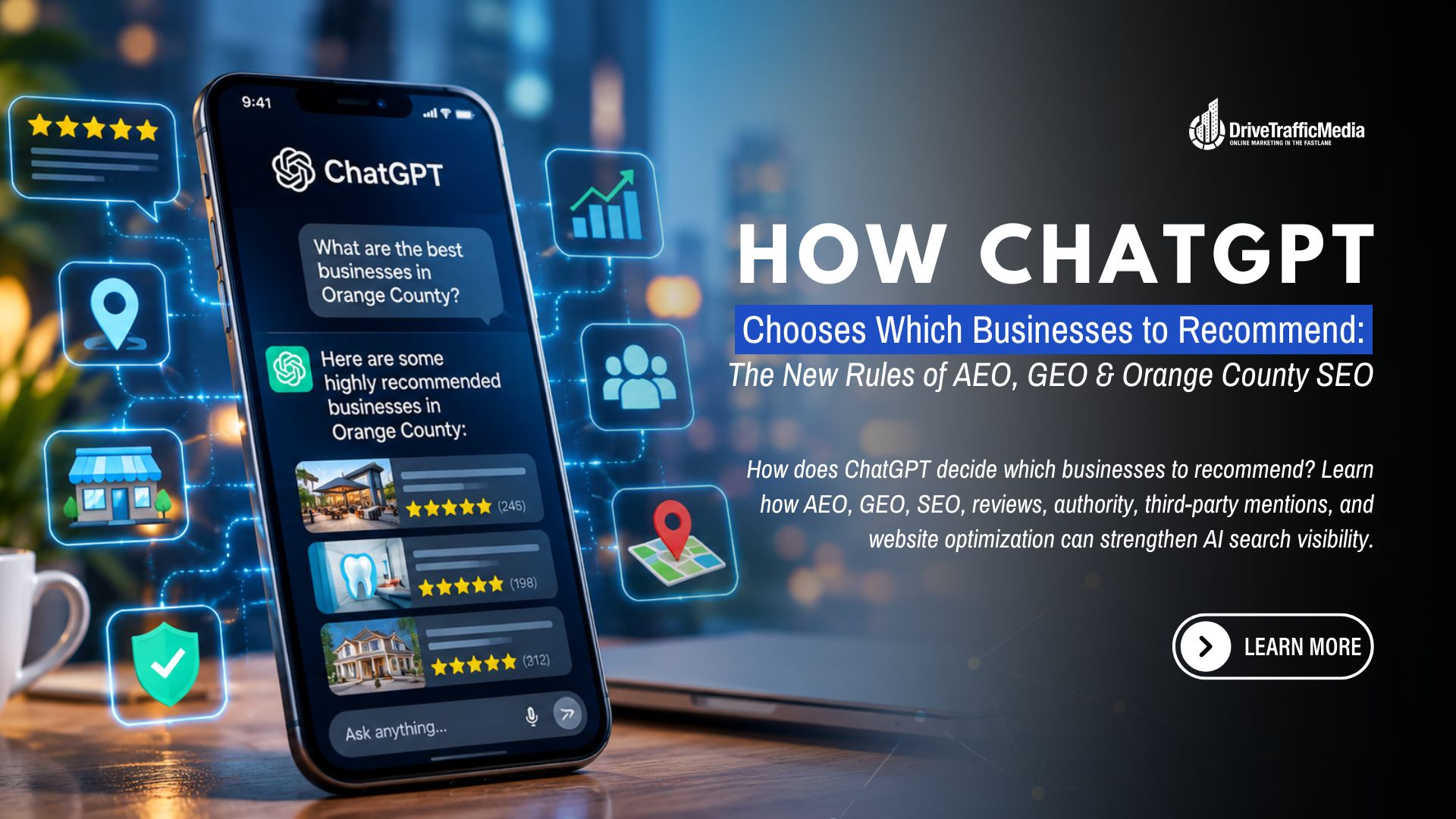
Ask ChatGPT a question like:
“Who is the best commercial electrician near me?”
“What are the best seafood restaurants in St. Petersburg?”
“Who should I hire for SEO in Orange County?”
“What is the best medical equipment store near Riverside?”
and you may receive something very different from a traditional Google search results page.
Instead of simply presenting ten blue links, ChatGPT can provide a conversational response that identifies businesses, explains why they may fit the request, compares options, and provides sources or additional information.
For business owners, this raises an enormously important question:
How does ChatGPT decide which businesses to recommend?
And perhaps an even more important question:
How do you increase the chances that ChatGPT recommends your business?
There is no secret button you can push, special meta tag you can install, or guaranteed formula that puts your company at the top of every ChatGPT answer.
What businesses can do is create a stronger digital presence that makes them easier for search engines and AI systems to discover, understand, verify, and consider relevant to a particular question.
That is where traditional Orange County SEO, AEO Orange County, and GEO Orange County increasingly come together.
SEO helps establish discoverability and authority.
AEO helps make your expertise and answers easier to understand.
GEO expands the strategy toward how your business, expertise, reputation, and digital footprint may be understood within generative AI experiences.
The future of online marketing isn’t simply about being ranked.
It’s about becoming understandable, credible, relevant, and recommendable.
Does ChatGPT Have a Business Ranking Algorithm?
This is one of the first misconceptions businesses need to understand.
There is no publicly disclosed formula where a business receives a fixed “ChatGPT ranking” similar to a traditional search position.
A business isn’t necessarily “#1 on ChatGPT.”
The recommendation can change depending on what the person asks.
Consider these questions:
What is the best Italian restaurant in Orange County?
What is the best Italian restaurant in Orange County for a romantic anniversary?
What is the best Italian restaurant near Irvine with outdoor seating?
What is a good inexpensive Italian restaurant for a family of six?
They sound similar, but they represent four different intents.
A restaurant that makes sense for one question might be a poor recommendation for another.
That distinction is fundamental to understanding AI search.
AI Recommendations Are Contextual
Traditional SEO trained businesses to think primarily about keywords and rankings.
Generative AI makes context increasingly important.
A person can tell ChatGPT:
“I’m looking for an electrician in Irvine who works on commercial buildings, handles panel upgrades, and can work around our office schedule.”
That’s far more specific than:
“electrician Irvine.”
To provide a useful answer, an AI-powered system needs enough reliable information to understand which businesses actually match those requirements.
This is one reason comprehensive service content is becoming so important.
If your website merely says:
“We provide electrical services.”
there isn’t much context.
A stronger website might clearly explain:
- Residential versus commercial work
- Specific electrical services
- Industries served
- Geographic service areas
- Licensing and credentials
- Emergency availability
- Types of projects completed
- Frequently asked questions
- Customer experiences
- Case studies
The clearer your business becomes online, the easier it is for both people and machines to determine when you’re relevant.
ChatGPT Can Search the Web for Current Information
Another important distinction is that ChatGPT isn’t limited to answering from static knowledge.
When current information is useful, ChatGPT Search can search the web and provide answers with links to relevant sources.
OpenAI explains that ChatGPT Search can rewrite a user’s question into one or more targeted searches and use the resulting information to construct a response. OpenAI also says search ranking uses multiple factors designed to surface relevant and reliable information.
That means your company’s broader web presence matters.
Your website matters.
But so can information about your business elsewhere on the internet.
For businesses, this changes the question from:
“How do I optimize one page for ChatGPT?”
to:
“How do I build a digital presence that consistently communicates who we are and why we’re relevant?”
That is a much more useful way to approach AI visibility.
First Requirement: Make Sure ChatGPT Can Access Your Website
Before worrying about sophisticated AI optimization strategies, start with something much more basic:
Can ChatGPT Search access your website?
OpenAI uses a crawler called OAI-SearchBot for search-related discovery.
OpenAI states that websites that want to appear in ChatGPT search results should allow OAI-SearchBot access. If your robots.txt configuration blocks it, your pages may not be eligible to appear through ChatGPT Search in the way you expect.
This is a technical issue businesses should add to their SEO audits.
Your marketing team should review:
- robots.txt
- Crawl directives
- Indexability
- Canonical tags
- Server responses
- JavaScript rendering
- Page speed
- Internal links
- XML sitemaps
- Broken pages
- Important content hidden behind inaccessible elements
This is a perfect example of why AI optimization does not eliminate traditional SEO.
Technical SEO remains foundational.
You cannot expect an AI-powered search experience to discover information that you’ve inadvertently made difficult to access.
Orange County SEO Still Provides the Foundation
The rise of ChatGPT, AI Overviews, Gemini, Copilot, Perplexity, and other generative platforms has caused some people to declare that SEO is dead.
That conclusion misunderstands how interconnected the web remains.
Strong Orange County SEO establishes many of the fundamentals that businesses also need for AI visibility.
These include:
- Crawlable websites
- Logical architecture
- Strong service pages
- Local landing pages
- Helpful content
- Internal linking
- Authoritative backlinks
- Accurate business information
- Mobile performance
- Website speed
- Structured information
- Strong brand signals
Search engines, AI-powered search products, third-party websites, and customers all need understandable information about your company.
A business with a thin five-page website, inconsistent company information, no reviews, no authoritative mentions, and generic content is providing the web with very little evidence about who it is.
A company with hundreds of useful resources isn’t automatically better either.
Quality matters more than simply creating pages.
The objective should be to build the clearest and most useful body of information about your business and expertise.
AEO Helps You Become Easier to Understand
This is where AEO Orange County becomes particularly important.
AEO stands for Answer Engine Optimization.
It focuses on making information easier for answer-driven systems—and people—to understand and use.
Imagine a prospective customer asks:
“How much does SEO cost in Orange County?”
One website might spend 1,500 words discussing digital marketing without ever providing a useful explanation.
Another might say:
SEO pricing varies based on competition, geographic reach, website condition, content requirements, backlink needs, and the number of services or locations being targeted.
Then it expands upon each factor.
The second approach is far more useful.
Good AEO content frequently uses:
- Question-based headings
- Direct answers
- Clear definitions
- FAQs
- Comparisons
- Tables where appropriate
- Step-by-step explanations
- Supporting evidence
- Logical page structure
- Natural conversational language
The goal isn’t to write robotic FAQ content for an algorithm.
The goal is to make expertise easy to understand.
That’s good marketing whether the reader is a person, a search engine, or an AI-powered answer system.
GEO Looks Beyond the Individual Answer
AEO and GEO are related, but they shouldn’t be treated as identical.
GEO Orange County—Generative Engine Optimization—takes a broader view of how a business or brand may establish visibility within generative AI experiences.
Imagine your company claims:
“We are one of Orange County’s leading digital marketing agencies.”
Anyone can put that sentence on a website.
The more interesting question is:
What exists elsewhere on the web to support the company’s identity and expertise?
For example:
- Does the business have genuine customer reviews?
- Are there independent mentions?
- Do authoritative websites link to it?
- Is its business information consistent?
- Does it publish original expertise?
- Are company representatives quoted elsewhere?
- Does it have useful videos?
- Does it maintain credible social profiles?
- Does its Google Business Profile support its location and services?
- Do reputable directories identify the same company?
- Does the business demonstrate real experience?
This is where the broader digital footprint becomes increasingly important.
Your own website tells the world what you say about yourself.
The rest of the internet can help establish what others say about you.
Your Website Needs to Clearly Explain What You Actually Do
This sounds obvious, but many websites fail here.
A homepage might say:
“Innovative solutions for tomorrow’s world.”
That may sound polished, but what does the company actually sell?
A local service business should make fundamental facts extremely clear:
Who are you?
What do you do?
Who do you serve?
Where do you serve them?
What problems do you solve?
Why should someone choose you?
How can they contact you?
Suppose an Orange County contractor serves Irvine, Newport Beach, Costa Mesa, Tustin, Anaheim, and Santa Ana.
That information should be easy to understand.
If the company specializes in commercial construction rather than residential remodeling, make that clear.
If it provides emergency service, say so.
If certain industries represent its primary expertise, explain them.
If you want AI systems to understand your company, don’t make them—or your customers—guess.
Service Pages Are Becoming More Important, Not Less
AI search makes comprehensive service pages particularly valuable because customers increasingly ask specific questions.
Someone isn’t necessarily searching:
“commercial cleaning company.”
They might ask:
“Find a commercial cleaning company that handles medical offices and can provide nightly cleaning.”
Another person might ask:
“Which commercial cleaning companies specialize in warehouses?”
Those questions require specificity.
A cleaning company’s website might therefore need dedicated information about:
- Office cleaning
- Medical facility cleaning
- Warehouse cleaning
- School cleaning
- Industrial cleaning
- Day porter services
- Floor care
- Carpet cleaning
- Disinfection
- Nightly janitorial programs
This is not about creating hundreds of nearly identical keyword pages.
It’s about documenting genuine capabilities in enough depth that prospects can determine whether the company is right for them.
That same clarity can help AI-powered systems understand the business.
Local Relevance Matters When the Question Is Local
Location can dramatically change a recommendation.
Someone asking:
“Who is a good SEO company?”
could potentially receive very different information from someone asking:
“Who is a good SEO company in Irvine, California?”
or:
“Which Orange County SEO company works with local service businesses?”
This is why local optimization remains important.
Businesses should maintain accurate:
- Addresses
- Service areas
- Business hours
- Phone numbers
- Google Business Profiles
- Local landing pages
- Location references
- Directory profiles
For a business targeting Orange County, simply mentioning “Orange County” repeatedly is not enough.
Real local relevance comes from demonstrating a genuine relationship with the market you serve.
Being Relevant Is Different From Being Trustworthy
This distinction becomes important as we move deeper into how AI recommendations work.
A website may be extremely relevant to a question.
That doesn’t automatically make it the strongest source.
For example, ten businesses might all claim to be:
“The best SEO company in Orange County.”
The phrase itself proves almost nothing.
Trust is built through a much larger collection of signals.
That’s where things become especially interesting for business owners—and where modern SEO starts expanding into reputation, reviews, third-party mentions, digital PR, social media, YouTube, Reddit, Yelp, BBB, local citations, structured data, and broader brand authority.
What Builds Trust, Authority, and Recommendation Potential in ChatGPT?
Relevance gets your business into the conversation.
Trust can help determine whether your business deserves consideration.
This distinction matters because modern AI search is not simply about matching a keyword on a webpage. When ChatGPT uses web search, OpenAI says its systems use multiple factors intended to surface information that is relevant and reliable.
For business owners, that means the goal should not be to manufacture an artificial signal that says, “Recommend us.”
The better strategy is to create a strong digital footprint that provides clear, consistent, credible evidence about the business.
That evidence can come from your own website—but it can also come from customers, authoritative websites, business profiles, reviews, directories, publications, videos, and online discussions.
This is where AEO Orange County, SEO, GEO, reputation management, content marketing, and digital PR begin functioning as one connected system.
Third-Party Mentions Can Strengthen the Story Around Your Business
Your website is a first-party source.
You control it.
That makes it essential, but it also means every claim you make about your own company should be viewed in context.
Imagine two businesses.
Business A says on its own website:
“We are one of the most trusted companies in Orange County.”
But there is very little information about the company elsewhere.
Business B has a detailed website, genuine customer reviews, industry mentions, local citations, interviews, social profiles, videos, directory listings, and articles from other websites discussing its expertise.
Which company has the stronger digital footprint?
Usually, Business B.
That does not mean ChatGPT follows a simple formula such as “more mentions = higher ranking.” No such public formula exists.
Instead, think about third-party information as corroboration.
When independent sources consistently reinforce facts about your company, the web contains more evidence from which search and AI systems can understand the business.
Why Backlinks Still Matter in the AI Era
Backlinks have been part of SEO for decades, and they remain important.
But businesses should think about backlinks as more than a number in an SEO report.
A good backlink can do several things:
- Help people discover your company
- Send referral traffic
- Associate your business with a relevant topic
- Help search engines discover content
- Strengthen traditional SEO authority
- Create another independent mention of your brand
The quality and relevance of the source matter enormously.
A legitimate article from a respected industry publication discussing your expertise is fundamentally different from hundreds of automated links placed on unrelated websites.
This is one reason Orange County SEO and GEO increasingly overlap.
SEO professionals have traditionally thought about backlinks in terms of ranking authority.
GEO adds another useful question:
What does the broader web say about this entity?
The strongest links often accomplish both.
Reviews Provide Information Your Website Cannot Create by Itself
Reviews deserve particular attention.
Your website can say:
“Our customer service is exceptional.”
A customer review saying:
“They answered the phone immediately, explained the process, arrived when promised, and solved our problem the same day”
provides a completely different type of evidence.
The review comes from someone other than the company.
Reviews can also provide context about:
- Services customers actually purchased
- Locations where customers received service
- Staff experiences
- Reliability
- Communication
- Quality
- Common customer concerns
- Real-world outcomes
For local businesses, reviews already play an important role in Google’s local ecosystem. Google says local results are primarily based on relevance, distance, and prominence, and notes that reviews and positive ratings can help local ranking.
Businesses should therefore view reputation management as part of both traditional local search and their broader AI-search strategy.
Don’t Turn Reviews Into Keyword-Stuffing Exercises
There is an important distinction here.
You should encourage genuine reviews.
You should not tell customers to write unnatural, keyword-loaded testimonials.
A review such as:
“Drive Traffic Media was great to work with and helped us understand our SEO strategy.”
sounds natural.
A review engineered to say:
“Best AEO Orange County SEO Orange County GEO Orange County digital marketing company Irvine California”
does not.
Your review strategy should focus on providing a great customer experience and making it easy for real customers to describe that experience honestly.
Authenticity is far more valuable than trying to manipulate the language customers use.
Google Business Profile Remains Essential for Local Businesses
For local companies, Google Business Profile remains one of the most important sources of business information online.
It can establish or reinforce:
- Business name
- Address
- Phone number
- Hours
- Website
- Business category
- Services
- Photos
- Reviews
- Geographic relevance
If your website says one thing and your Google Business Profile says another, you create unnecessary confusion.
For example:
Your website says you’re open until 6:00 PM.
Google says 5:00 PM.
Yelp says 7:00 PM.
Facebook says you’re closed.
Which one is correct?
This is a basic example, but it illustrates a larger GEO principle:
Consistency makes an entity easier to understand.
Maintaining accurate business information is not glamorous, but it is fundamental.
Yelp Can Become Another Source of Independent Business Information
Yelp should not be viewed merely as another place to collect stars.
A complete Yelp profile can provide:
- Business information
- Categories
- Services
- Customer reviews
- Photographs
- Website information
- Location information
- Hours
- Descriptions
For certain industries and locations, customers actively use Yelp while researching businesses.
That alone makes the platform worth considering.
But from a broader GEO Orange County perspective, Yelp can also contribute another independent source of information about the business.
Again, this does not mean:
“Create a Yelp page and ChatGPT will recommend you.”
That would be an unjustified promise.
Instead:
Maintain accurate profiles on credible platforms where customers genuinely research companies.
That’s useful for people first—and creates a healthier digital footprint at the same time.
What About the Better Business Bureau?
The Better Business Bureau can serve a similar corroborative purpose.
A BBB profile may contain information about:
- Company identity
- Contact information
- Business history
- Accreditation, when applicable
- Customer complaints
- Customer reviews
- Business responses
For industries where trust is especially important, prospects may investigate BBB before making a decision.
From an AI-search perspective, the important concept isn’t that BBB provides a magical ranking signal.
It is that credible third-party sources can help establish information about a business outside the company’s own website.
Your goal should be to make important facts about your organization easy to verify.
Reddit Has Become Difficult for Businesses to Ignore
Reddit deserves its own discussion because it represents something very different from a business directory.
People use Reddit to ask questions such as:
“Who has actually used this company?”
“Which SEO agency would you recommend?”
“What plumber do locals use?”
“Which restaurant isn’t just a tourist trap?”
“Has anyone bought from this company?”
These discussions can provide candid experiences and perspectives that polished marketing websites rarely contain.
Reddit can therefore become part of the research journey even when it isn’t the final conversion point.
But businesses need to approach Reddit differently from conventional advertising.
Showing up in a community and pretending to be an independent customer praising your own company is not a sustainable strategy.
Participating transparently, answering questions when appropriate, sharing expertise, and earning genuine discussion is far more valuable.
You cannot manufacture authentic community reputation at scale without eventually damaging trust.
YouTube Can Demonstrate Expertise in Ways Written Content Cannot
Suppose two roofing companies both have optimized service pages.
One also has a YouTube channel explaining:
- How to identify roof damage
- What happens during an inspection
- How different roofing materials compare
- What homeowners should expect during replacement
- Common mistakes
- Actual projects
- Frequently asked questions
Which company gives a prospective customer more opportunities to evaluate its expertise?
Video creates another layer of evidence.
Customers can see the people behind the business.
They can hear explanations.
They can evaluate whether the company appears knowledgeable.
They can see projects, processes, products, locations, and outcomes.
This is one reason YouTube should increasingly be viewed as part of a complete search strategy rather than a completely separate social-media project.
The future of search is becoming increasingly multimodal.
Your expertise should not exist exclusively as text.
Social Media Helps Build the Broader Brand Footprint
Social media is often misunderstood in SEO discussions.
Posting on Facebook or LinkedIn does not mean a page will suddenly jump ten positions in Google.
The value is broader.
Social media can:
- Distribute content
- Build brand awareness
- Generate branded searches
- Demonstrate activity
- Showcase expertise
- Introduce employees and leadership
- Share videos
- Highlight customer experiences
- Promote original research
- Create additional brand touchpoints
A business that publishes a genuinely useful article should not necessarily leave that information sitting silently on its website.
Turn the article into a LinkedIn discussion.
Create a YouTube video.
Record several Shorts.
Create a Facebook post.
Answer related questions.
Reference the resource when useful.
One strong idea can become a network of useful information across multiple channels.
That’s substantially more powerful than publishing endless thin articles simply to hit a monthly content quota.
Brand Consistency Helps Machines Understand Entities
Consider how many different ways a business might describe itself online.
One profile says:
Drive Traffic
Another says:
Drive Traffic Media
Another says:
DriveTrafficMedia.com
Another uses an outdated address.
Another lists an old phone number.
Another describes completely different services.
Humans may figure out that these references represent the same company.
Machines also need to resolve those relationships.
This is why entity consistency matters.
Keep important company information accurate across major platforms:
- Official business name
- Address
- Phone
- Website
- Logo and branding
- Primary categories
- Services
- Leadership information when relevant
- Geographic service areas
- Social profiles
This isn’t about making every sentence identical.
It’s about ensuring the underlying facts don’t conflict.
Schema Markup Can Help Clarify Information
Structured data, commonly implemented using Schema.org vocabulary, provides machine-readable information about the content on a webpage.
Depending on the page, relevant structured data may describe things such as:
- Organizations
- Local businesses
- Articles
- Products
- Events
- Breadcrumbs
- Videos
- People
Schema should accurately represent content that genuinely exists on the page.
It is not a secret ChatGPT ranking code.
Adding schema does not guarantee that ChatGPT recommends a business.
But structured data can help machines interpret information and is already an important component of modern search optimization.
For businesses investing in SEO, AEO, and GEO, accurate structured data belongs in the technical toolkit.
Your “About” Page Is More Important Than Many Businesses Realize
Many companies treat the About page as an afterthought.
They shouldn’t.
A strong About page can clearly establish:
- Who founded the business
- When it was established
- Where it operates
- What it specializes in
- Who leads the organization
- Experience
- Credentials
- Mission
- Relevant history
This helps customers understand the people and organization behind the services.
It also gives search systems a clearer source of first-party information about the business entity.
Avoid turning the About page into meaningless corporate language.
Instead of:
“We leverage synergistic solutions to empower next-generation outcomes.”
tell people something useful.
Who are you?
Why does the company exist?
What experience do you have?
Who do you serve?
What makes your approach different?
Specificity builds credibility.
Original Expertise Is Becoming a Competitive Advantage
AI makes it incredibly easy to create generic information.
That makes original information more valuable, not less.
If 500 websites publish essentially the same article explaining “10 SEO Tips,” why should anyone care about the 501st?
Businesses should increasingly publish information that only they can provide.
For example:
- Original case studies
- Customer questions your sales team hears repeatedly
- Lessons from actual projects
- Industry observations
- Before-and-after examples
- Internal data
- Expert commentary
- Original photographs
- Original videos
- First-hand comparisons
- Mistakes you’ve seen customers make
- Real solutions your team has implemented
This is where experience becomes content.
A plumbing company has knowledge that generic publishers don’t.
An electrician has knowledge that generic publishers don’t.
A medical equipment specialist has knowledge that generic publishers don’t.
A commercial cleaning company has knowledge that generic publishers don’t.
Your marketing strategy should extract that expertise and turn it into useful digital assets.
Don’t Publish AI Content Just Because You Can
Generative AI has dramatically reduced the cost and time required to create content.
That is useful.
It is also dangerous when businesses mistake volume for authority.
Publishing 500 generic articles does not automatically create expertise.
A better question is:
Does this page contribute something useful to our website?
Every new page should have a reason to exist.
Maybe it answers an important customer question.
Maybe it documents a service.
Maybe it covers a geographic market.
Maybe it provides original research.
Maybe it compares solutions.
Maybe it demonstrates expertise.
Maybe it supports a critical stage in the customer’s decision process.
AI can assist with research, organization, ideation, editing, and production.
But businesses still need human experience, judgment, fact-checking, originality, and a reason for publishing.
Digital PR May Become Even More Valuable
Traditional link building frequently asks:
How can we get a backlink?
Digital PR asks a better question:
How can we become worth talking about?
That could mean:
- Publishing original research
- Providing expert commentary
- Supporting community initiatives
- Releasing useful data
- Creating tools
- Publishing industry reports
- Producing noteworthy case studies
- Participating in interviews
- Contributing expert insight
The resulting mentions can produce links, citations, branded searches, referral traffic, and independent evidence of expertise.
This aligns extremely well with GEO.
Rather than trying to manufacture authority, create something authoritative.
Why “Best Company” Lists Need to Be Treated Carefully
Businesses understandably want to appear when someone asks ChatGPT:
“What’s the best company for ___?”
But “best” is contextual.
Best according to what?
- Lowest price?
- Highest reviews?
- Closest location?
- Most experience?
- Particular specialty?
- Availability?
- Customer preferences?
This is why businesses should avoid obsessing over one generic prompt.
Your objective shouldn’t be:
“Make ChatGPT say we’re the best.”
Your objective should be:
“Make our genuine strengths extremely easy to understand and verify.”
If you specialize in something, document it.
If you’ve been operating for 20 years, state it accurately.
If you serve a particular market, make it clear.
If customers consistently praise a specific strength, pay attention to that feedback.
Strong positioning helps both humans and AI systems understand when your company is the right fit.
The Question Determines the Recommendation
This may be the single most important concept in the entire article.
Imagine someone asks ChatGPT:
“Recommend an Orange County marketing agency.”
Then compare it with:
“Recommend an Orange County marketing agency that specializes in local SEO for service businesses and understands AEO and GEO.”
The second question contains dramatically more context.
This means businesses need to stop thinking only about broad category keywords.
You should also build content around the attributes and specialties that make you relevant to specific customers.
For Drive Traffic Media, for example, that means clearly explaining areas such as Orange County SEO, AEO Orange County, GEO Orange County, web design, content strategy, paid advertising, social media, and other services actually provided.
The more specific the customer becomes, the more valuable clear positioning becomes.
This Is Why AI Search Is Really a Brand-Building Challenge
At first glance, businesses may think ChatGPT optimization is another technical marketing tactic.
Add some schema.
Write some FAQs.
Mention ChatGPT.
Create an “AI optimized” page.
Done.
That misses the larger opportunity.
AI search increasingly rewards the same fundamental qualities that strong businesses should have been developing all along:
Clarity.
Expertise.
Relevance.
Trust.
Reputation.
Authority.
Consistency.
Usefulness.
The technical components matter.
But the long-term challenge is much bigger:
Build a business whose digital presence provides enough credible evidence that recommending it makes sense.
How to Increase Your Chances of Being Recommended by ChatGPT
Understanding how AI search works is useful, but business owners ultimately want to know what to do about it.
There is no legitimate way to guarantee that ChatGPT will recommend a particular company for a particular prompt. The practical opportunity is to strengthen the signals that make your business easier to discover, understand, verify, and match to relevant customer needs.
That requires much more than adding “ChatGPT” to a few webpages.
A comprehensive strategy combines Orange County SEO, AEO Orange County, GEO Orange County, content, technical optimization, reputation, third-party authority, local visibility, and brand building.
Here is how businesses can begin.
Step 1: Audit What ChatGPT Currently Knows About Your Business
Start by researching your own company as a prospective customer might.
Don’t test only:
“Tell me about [Company Name].”
That tells you relatively little about your competitive visibility.
Instead, test questions representing actual customer intent.
For a digital marketing company, these might include:
“What are some digital marketing agencies in Orange County?”
“Which SEO companies serve Irvine?”
“What companies specialize in AEO in Orange County?”
“Which Orange County marketing agencies understand GEO and AI search?”
“What marketing agencies specialize in local service businesses?”
Then become more specific.
Ask questions based on:
- Location
- Service
- Industry
- Customer type
- Problem
- Budget considerations
- Specialty
- Experience
- Desired outcome
Record what appears.
Which competitors are mentioned?
What sources support the answer?
What attributes are associated with each company?
Is your company described accurately?
Does your company appear at all?
Testing does not give you a universal “ChatGPT ranking,” because results can vary with context and current web information. It does give you useful insight into the digital information available about your market.
Step 2: Search Your Brand as an Entity, Not Just a Keyword
Next, investigate your company’s broader footprint.
Search for:
Company name
Company name + reviews
Company name + location
Company name + service
Company name + owner
Company name + Yelp
Company name + BBB
Company name + LinkedIn
Company name + Reddit
Company name + YouTube
Then ask an important question:
Does the internet tell a consistent story?
You may discover:
- An old address
- Incorrect hours
- Abandoned profiles
- Outdated descriptions
- Duplicate listings
- Incorrect service information
- Old branding
- Missing leadership information
- Weak review profiles
Fixing these issues is basic digital housekeeping, but it also supports the entity clarity discussed throughout this article.
Step 3: Strengthen Your Core Service Pages
Your website should contain a substantial page for every major service you genuinely provide.
A digital marketing agency, for example, shouldn’t have one page saying:
“We do SEO, websites, ads and social media.”
Each important service deserves enough information to explain:
- What the service is
- Who needs it
- Problems it solves
- How the process works
- What customers should expect
- Relevant geographic markets
- Common questions
- Related services
- Why experience matters
- What makes the company’s approach different
This creates far more useful context.
It also prevents your homepage from trying to rank for and explain everything simultaneously.
Step 4: Build Location Relevance Carefully
Local companies should clearly document where they operate.
But this is an area where businesses frequently create low-quality content.
Publishing 100 nearly identical city pages and replacing only the city name is not a strong long-term strategy.
A useful location page should provide genuine local value.
For example, an Orange County marketing company might explain:
- Industries common to the area
- Local competitive conditions
- Communities served
- Relevant services
- Local business challenges
- Examples or experience where appropriate
- Questions local clients frequently ask
If Irvine is an important market, explain why.
If you serve all of Orange County, clearly document that relationship.
Geographic relevance should be demonstrated, not merely repeated.
Step 5: Build Content Around Questions Customers Actually Ask
Your sales team is one of your best keyword-research tools.
Write down the questions prospects ask during:
- Sales calls
- Consultations
- Emails
- Walkthroughs
- Estimates
- Customer-service conversations
Those questions often reveal the content your website is missing.
For an SEO company, examples might include:
- How long does SEO take?
- How much does SEO cost?
- Why did my rankings drop?
- Do I need backlinks?
- Does ChatGPT change SEO?
- What’s the difference between SEO, AEO, and GEO?
- Can AI recommend my business?
- Does Google Business Profile matter?
- Do Yelp reviews help?
- How important is Reddit?
- Should my company create YouTube videos?
Each question could become a section, FAQ, video, article, or even a full service resource.
This is AEO Orange County in practice: creating genuinely useful answers around real customer intent.
Step 6: Answer the Question Early
One of the simplest improvements you can make is to stop burying answers.
If the heading asks:
How long does SEO take?
Don’t begin with five paragraphs about the history of search engines.
Answer it.
Then explain the variables.
A useful structure is:
Question → direct answer → explanation → evidence/examples → next logical question.
This works because people appreciate clarity.
AEO should improve the customer experience, not turn content into something written exclusively for machines.
Step 7: Create Topic Clusters Instead of Random Blogs
Many companies publish blogs without an overall architecture.
January: SEO tips.
February: Valentine’s Day.
March: social media.
April: company anniversary.
May: five random marketing trends.
There is nothing connecting the content.
A stronger strategy builds topic clusters.
For example:
AI Search Visibility
A cornerstone resource could be supported by articles about:
- How ChatGPT recommends businesses
- What AEO is
- What GEO is
- SEO vs. AEO
- AEO vs. GEO
- ChatGPT Search
- Google AI Overviews
- AI search and local businesses
- Reviews and AI recommendations
- Reddit and AI search
- Schema for AI visibility
- How to measure AI traffic
Those articles can naturally link to one another and to relevant service pages.
Drive Traffic Media has already begun building this type of relationship among Orange County SEO, AEO, GEO, and AI-search content.
The objective is to become genuinely comprehensive around a subject rather than publishing isolated pages targeting individual phrases.
Step 8: Use Internal Linking to Explain Relationships
Internal links aren’t merely navigation.
They help establish relationships between information.
If an article discusses Answer Engine Optimization, linking naturally to the primary AEO resource helps users explore the topic.
If it then explains Generative Engine Optimization, link to the GEO resource.
If it discusses traditional organic search, link to the SEO service page.
This produces a logical knowledge structure.
However, don’t link every occurrence of every keyword.
That makes content distracting and unnatural.
A handful of relevant contextual links is usually much more useful than turning every paragraph into a collection of hyperlinks.
Step 9: Strengthen Your First-Party Evidence
One of the biggest opportunities in the AI era is publishing information competitors cannot easily duplicate.
Create:
- Case studies
- Project examples
- Original photography
- Original videos
- Testimonials
- Expert commentary
- Internal research
- Surveys
- Before-and-after examples
- Detailed processes
- Lessons from actual work
- Industry-specific observations
Suppose your company has managed SEO campaigns for 15 years.
What have you learned?
What mistakes repeatedly hurt businesses?
What changes have produced results?
What questions do customers misunderstand?
That knowledge is far more interesting than another generic article called “7 Benefits of SEO.”
Step 10: Create a YouTube Strategy Around Your Expertise
YouTube deserves more attention in AI-search strategies.
Don’t limit video to polished advertisements.
Create videos that answer actual questions.
A marketing company could produce videos such as:
- How does ChatGPT choose businesses?
- Does SEO still work in 2026?
- What is AEO?
- What is GEO?
- How important are Google reviews?
- Why isn’t my website ranking?
- How long does SEO take?
- What should a service landing page contain?
One detailed article can generate multiple videos.
One long video can generate Shorts.
Those Shorts can become social posts.
The article can embed the video.
The video description can reference the related resource.
Now one useful idea exists in several formats.
That’s a much stronger content ecosystem.
Step 11: Build Real Third-Party Authority
Your company’s authority should not exist exclusively on domains you own.
Look for legitimate opportunities to earn:
- Interviews
- Press mentions
- Guest commentary
- Industry features
- Local news coverage
- Podcast appearances
- Association listings
- Expert contributions
- Relevant directory listings
- Community coverage
The operative word is legitimate.
Third-party authority works best when there is a genuine reason for another publication to discuss your company or expertise.
Step 12: Treat Reddit as a Community, Not a Link-Building Platform
Reddit can influence discovery and research, but the wrong approach can backfire.
Don’t create fake conversations praising your company.
Don’t mass-post links.
Don’t disguise advertising as customer advice.
Instead, businesses and experts can participate transparently where appropriate.
Answer questions.
Explain complicated subjects.
Correct misconceptions.
Share useful experiences.
If linking to a resource genuinely improves an answer and community rules permit it, then the link has a reason to exist.
The goal is reputation, not manipulation.
Step 13: Make Your Business Easy to Verify
Ask whether a researcher can independently confirm important facts about your business.
For example:
- Is the address accurate?
- Does the phone number match?
- Is the company leadership identifiable?
- Are services documented?
- Are reviews available?
- Are social profiles legitimate?
- Are important credentials verifiable?
- Does the company have a meaningful history?
- Are third-party references available?
The stronger and more consistent this evidence becomes, the clearer the business’s digital identity becomes.
This principle is central to GEO Orange County.
Step 14: Don’t Forget Conversion Optimization
Being mentioned by ChatGPT is worthless if the resulting visitor lands on a terrible website.
Imagine ChatGPT sends a qualified prospect to your website.
Then:
- The page takes eight seconds to load.
- The phone number is difficult to find.
- The website looks broken on mobile.
- There is no clear CTA.
- The service description is vague.
- The contact form has 15 required fields.
- There are no reviews or testimonials.
- The page looks abandoned.
You won the discovery battle and lost the customer.
Modern SEO needs to connect visibility with conversion.
Every important page should answer:
What should the visitor do next?
Call?
Request an estimate?
Schedule a consultation?
Book an appointment?
Buy?
Visit?
The next step should be obvious.
Step 15: Measure AI Referral Traffic
Businesses should begin tracking traffic from AI platforms as part of their analytics.
Depending on how a visit occurs and how analytics categorizes it, referral data can help reveal traffic from AI and conversational search platforms.
Monitor:
- Referral traffic
- Landing pages
- Conversions
- Engagement
- Assisted conversions
- Branded searches
- Lead-source information
Don’t focus only on traffic volume.
Twenty highly qualified AI referrals that generate five consultations can be more valuable than thousands of irrelevant visits.
Ultimately, marketing should be evaluated against business outcomes.
What NOT to Do to “Rank in ChatGPT”
As AI visibility becomes more valuable, businesses will inevitably encounter shortcuts promising guaranteed ChatGPT rankings.
Be skeptical of tactics built around manipulation rather than usefulness.
Avoid strategies such as:
- Creating fake reviews
- Creating fake Reddit discussions
- Publishing hundreds of near-identical AI pages
- Claiming credentials you don’t possess
- Fabricating awards
- Inventing statistics
- Publishing fake testimonials
- Creating misleading comparison pages
- Keyword stuffing
- Repeating “best company” everywhere
- Hiding text intended only for machines
- Buying large volumes of irrelevant backlinks
These tactics do not build genuine authority.
They build noise.
The long-term opportunity is to make your business more useful and verifiable, not more manipulative.
The ChatGPT Business Visibility Checklist
Business owners can use the following checklist as a starting point.
Technical Foundation
- Website is crawlable
- OAI-SearchBot isn’t unintentionally blocked
- Important pages are indexable
- XML sitemap is accurate
- Canonicals are correct
- Mobile experience works properly
- Site loads quickly
- Broken links are addressed
- HTTPS is implemented
- Important information isn’t unnecessarily hidden
Business Entity
- Company name is consistent
- Address is accurate
- Phone number is accurate
- Website URL is consistent
- Services are clearly documented
- Service areas are clear
- Leadership information is available where appropriate
- About page is comprehensive
- Social profiles are current
Content
- Every important service has useful content
- Important locations are represented appropriately
- Customer questions are answered
- FAQs are genuinely helpful
- Content demonstrates real expertise
- Articles are internally connected
- Original examples are included
- Content is updated when facts change
Reputation
- Google reviews are actively managed
- Negative feedback receives professional responses
- Yelp information is accurate where relevant
- BBB information is accurate where relevant
- Industry profiles are maintained
- Customer testimonials are authentic
Authority
- Relevant websites mention the company
- Backlinks come from legitimate sources
- Experts contribute to industry discussions
- Original research or insights are published
- Digital PR opportunities are pursued
- Community involvement is documented where relevant
Multimedia
- Original photographs exist
- Useful videos are published
- YouTube is used when appropriate
- Videos answer customer questions
- Important visuals support the written content
AEO
- Important questions receive direct answers
- Headings clearly describe sections
- Definitions are concise
- Comparisons are easy to understand
- Content uses natural language
- Supporting details follow direct answers
GEO
- Brand information is consistent across the web
- Third-party sources corroborate important facts
- Expertise exists beyond the company’s own website
- The company is associated with its genuine specialties
- Online reputation supports positioning
- Content and mentions build a coherent entity
Conversion
- Phone numbers are easy to find
- CTAs are clear
- Forms are simple
- Service pages explain next steps
- Trust signals appear near conversion points
- Mobile conversion is easy
If you’re weak in several of these categories, don’t panic.
That is the opportunity.
Improve the digital footprint systematically.
Frequently Asked Questions About ChatGPT Business Recommendations
Can I pay ChatGPT to recommend my business?
Organic recommendations should not be treated as paid rankings. A business should focus on building genuine relevance, authority, accurate information, and a strong web presence rather than attempting to buy an organic recommendation.
Can I guarantee my business appears in ChatGPT?
No. There is no legitimate method for guaranteeing that a business will appear for every relevant ChatGPT question.
The recommendation depends heavily on the user’s request, context, available information, and how the system handles that particular query.
How do I get my business recommended by ChatGPT?
Start by making the business easy to discover, understand, and verify. Build a technically sound website, comprehensive service information, accurate local profiles, authentic reviews, authoritative third-party mentions, useful content, and a consistent brand footprint.
Does SEO help businesses appear in ChatGPT?
SEO can contribute significantly to the underlying digital foundation.
A strong Orange County SEO strategy improves crawlability, website structure, content quality, authority, local relevance, and discoverability—all valuable regardless of whether a customer begins with Google or an AI-powered search experience.
What is the difference between SEO and AEO?
SEO focuses broadly on improving visibility through search engines.
AEO, or Answer Engine Optimization, places additional emphasis on making information easy for answer-driven experiences to understand and present.
The strategies overlap considerably and should generally support each other.
What is the difference between AEO and GEO?
AEO focuses heavily on making individual answers clear and useful.
GEO, or Generative Engine Optimization, takes a broader approach to visibility within generative experiences, including content, entity understanding, brand authority, third-party corroboration, and the wider digital footprint.
Do reviews help ChatGPT recommend a business?
Reviews can contribute useful independent information about a business and already influence how customers evaluate companies. They should be considered one component of a much broader reputation and authority strategy rather than a guaranteed ChatGPT recommendation factor.
Does Google Business Profile matter?
For local businesses, absolutely.
Google Business Profile provides important information about location, categories, hours, reviews, services, and contact details. Maintaining an accurate profile supports local visibility and makes your business information easier to verify.
Does Reddit matter for AI search?
Reddit can matter because real customers frequently use it to discuss companies, products, services, and experiences.
The correct strategy isn’t manipulating Reddit. It’s earning authentic discussion and participating transparently when appropriate.
Does YouTube help?
Video gives businesses another way to demonstrate expertise, answer questions, show real projects, and build brand recognition.
For many businesses, YouTube should be considered part of the larger content and search ecosystem.
How long does it take to improve AI search visibility?
There is no universal timeline.
A company with an established website, strong authority, many reviews, and substantial third-party coverage begins from a very different position than a new company with almost no digital footprint.
Think of AI visibility as authority building, not a one-time optimization.
SEO + AEO + GEO: The New Search Strategy
The biggest mistake businesses can make is treating SEO, AEO, and GEO as competing marketing philosophies.
They should work together.
SEO establishes the technical, content, local, and authority foundation.
AEO improves how clearly your website answers questions.
GEO expands the strategy into the broader ecosystem of generative search, entities, citations, reputation, authority, and third-party corroboration.
A company that combines all three isn’t abandoning Google.
It’s preparing for a world where customers may discover businesses through:
- Google Search
- Google Maps
- AI-generated search experiences
- ChatGPT
- Gemini
- Microsoft Copilot
- Perplexity
- YouTube
- Social media
- Review platforms
- Industry websites
The customer journey is becoming distributed.
Your marketing strategy should be as well.
How Drive Traffic Media Helps Businesses Prepare for AI Search
Drive Traffic Media has spent more than 16 years helping businesses adapt to changes in online marketing.
Search has evolved repeatedly during that time.
Mobile changed search.
Google Maps changed local discovery.
Social media changed brand visibility.
Video changed content consumption.
Artificial intelligence is now changing how people research, compare, and choose businesses.
But the underlying objective remains remarkably consistent:
Help the right customer discover the right business and give that customer enough confidence to take action.
Drive Traffic Media approaches this new environment by bringing together Orange County SEO, AEO Orange County, GEO Orange County, website development, content creation, local optimization, social media, paid advertising, reputation strategy, and conversion optimization.
Because no single tactic creates a complete digital presence.
AEO without a technically healthy website is limited.
SEO without useful content is limited.
GEO without genuine authority is limited.
Traffic without conversion is limited.
Content without distribution is limited.
Reviews without strong service are limited.
The advantage comes from making all of these elements work together.
Final Thoughts: Become a Business Worth Recommending
So, how does ChatGPT choose which businesses to recommend?
There is no single public checklist or fixed ranking formula that guarantees selection.
The better way to think about the question is:
What information exists that makes your business relevant, understandable, trustworthy, and appropriate for the person’s request?
That’s the opportunity.
Don’t optimize merely to tell ChatGPT you’re the best.
Build the evidence.
Create a technically strong website.
Explain your services clearly.
Answer real customer questions.
Build authoritative content.
Earn genuine reviews.
Keep your business information accurate.
Publish original expertise.
Create useful videos.
Strengthen your local presence.
Earn legitimate third-party mentions.
Build a brand people actually discuss.
Connect your SEO, AEO, and GEO strategies.
And make the experience excellent when someone finally reaches your website.
AI search will continue evolving. The platforms will change. Interfaces will change. How recommendations are generated will continue developing.
But businesses that are genuinely useful, authoritative, relevant, visible, and trusted will have something much more valuable than a temporary optimization trick.
They’ll have a digital reputation worth recommending.
And that is exactly what businesses should be building now.