
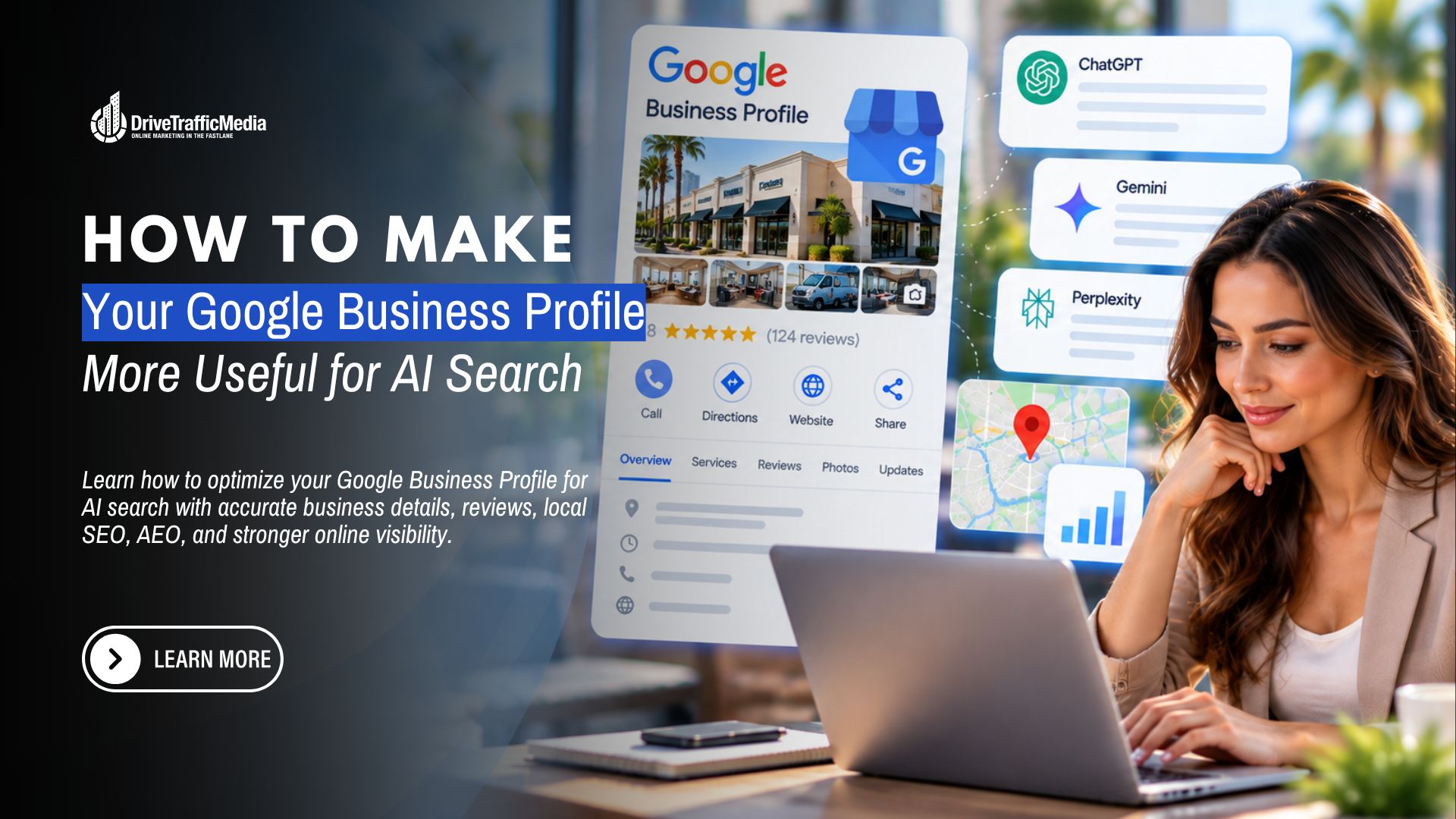
Artificial intelligence is changing how customers discover local businesses. People still use Google Search and Google Maps to find nearby companies, but they are also asking AI-powered platforms more detailed questions about services, locations, customer experiences, and which businesses might be the best fit.
Someone might ask:
“Which commercial cleaning companies serve medical offices in Orange County?”
“Where can I find a mobility equipment supplier near Costa Mesa?”
“What should I look for when choosing a digital marketing agency in Irvine?”
These questions go beyond traditional keyword searches. Customers want useful answers that help them compare businesses and make decisions.
For local companies, this creates an important opportunity: making sure the information available about their business is accurate, detailed, consistent, and easy to understand.
One of the most important places to begin is your Google Business Profile.
A properly maintained Google Business Profile can help customers find your company through Google Search and Maps. It also provides structured business information that can support Google’s AI-powered local discovery experiences.
For businesses investing in Orange County SEO, improving a Google Business Profile should be part of a broader strategy that includes website content, customer reviews, local relevance, Answer Engine Optimization (AEO), and Generative Engine Optimization (GEO).
The goal is not to trick an AI platform into recommending your company.
It is to make your business easier to discover, understand, and evaluate.
Why Google Business Profile Matters for AI Search
Google Business Profile has traditionally been associated with Google Maps and local search results.
When someone searches for a restaurant, contractor, retail store, or local service provider, Google may display business listings containing contact details, hours, reviews, photos, directions, and other useful information.
These listings help customers evaluate their options without visiting several websites.
As Google develops AI-powered search experiences, accurate business information becomes increasingly valuable.
Google’s AI features can present local business information alongside summaries, recommendations, and other search results.
However, a complete Google Business Profile does not guarantee that a company will appear in an AI-generated answer.
Google’s documented local ranking considerations include relevance, distance, and prominence. Accurate business details help establish relevance, while reviews and broader online recognition can contribute to prominence.
For business owners, the practical takeaway is straightforward.
The more accurately your Google Business Profile represents your actual business, the easier it becomes for customers and Google’s systems to understand what you offer.
1. Make Sure Your Business Information Is Complete and Accurate
Start with the fundamentals.
Your Google Business Profile should accurately reflect the company customers will encounter when they call, visit, or request services.
Review your business name, address or service area, phone number, website, hours, business category, and available attributes.
These details should match your real operations.
For example, a company that serves customers at their locations should configure its service-area information appropriately.
A retail business should provide its correct storefront address and current operating hours.
A service provider should avoid listing locations where it does not actually operate.
Accurate information matters because customers rely on these details when deciding whether a business is relevant to their needs.
It also helps prevent conflicting information from appearing across search results and online business listings.
Why consistency matters
Imagine a potential customer finds one phone number on Google Maps, another on your website, and a different address on a directory listing.
That creates uncertainty.
Even if the business is legitimate, inconsistent information can make it harder for customers to determine which details are correct.
Review your website, Google Business Profile, social media accounts, and major directory listings to ensure that essential information is consistent.
This is a foundational part of local SEO and a sensible preparation step for AI-powered discovery.
2. Choose Business Categories That Reflect Your Actual Services
Your Google Business Profile category helps Google understand the type of business you operate.
Choosing the most accurate primary category is more important than selecting a broad category simply because it sounds popular.
For example, a business specializing in commercial cleaning should choose an available category that accurately reflects its main operations.
A personal training business should identify the category that best describes its services.
A digital marketing company should select the category that represents its core business rather than attempting to appear under every related marketing category.
Additional categories can be useful when they accurately describe other significant parts of the business.
However, adding unrelated categories does not create genuine relevance.
Why categories matter for AI discovery
Consider someone asking:
“Which businesses provide commercial cleaning services for office buildings near me?”
A clearly categorized business with accurate service information gives Google useful context for matching the company to relevant local searches.
Categories alone do not determine recommendations, but they help establish what the business actually does.
The objective should be accuracy rather than attempting to manipulate search results.
3. Write a Business Description That Explains What Makes You Relevant
Many companies treat their Google Business Profile description as an afterthought.
They may write a short paragraph filled with generic statements such as “quality service,” “customer satisfaction,” and “the best company in town.”
Those phrases provide little meaningful information.
A stronger description explains what the company does, whom it serves, where it operates, and what makes its services distinctive.
For example, a commercial cleaning company might describe the types of facilities it serves, its geographic coverage, and its primary cleaning services.
A window treatment company could explain its custom shutters, blinds, and shades, along with the communities it serves.
A fitness professional might describe available personal training options and the clients those services are designed to support.
The description should be factual, specific, and easy to understand.
Google allows up to 750 characters for a Business Profile description, so prioritize useful information instead of trying to include every possible keyword.
How AI can help improve your description
AI writing tools can help organize information or suggest clearer wording.
However, business owners should review every suggestion for accuracy.
An AI-generated description should not invent services, locations, awards, certifications, or experience.
The final description should reflect the real business.
4. Add Detailed Services and Relevant Business Attributes
One of the most useful improvements business owners can make is reviewing the services and attributes available within their Google Business Profile.
A business may offer several services that are not immediately obvious from its primary category.
For example, a commercial cleaning company may provide office cleaning, floor care, janitorial services, or other specialized services.
A medical equipment supplier may offer mobility scooters, powerchairs, lift chairs, equipment rentals, and repairs.
A marketing agency may provide SEO, web design, social media marketing, and paid advertising.
When the appropriate fields are available, these services should be described accurately.
Relevant attributes can also help customers understand practical details about the business.
The available options vary by business category and location.
Avoid adding services you don’t provide
It may be tempting to list additional services simply because they receive search traffic.
That approach creates problems.
If someone contacts your company expecting a service you do not provide, the interaction wastes time and damages confidence.
Accurate service information helps attract more appropriate inquiries.
The goal of Google Business Profile optimization is not to appear for every possible search.
It is to become more relevant to searches that genuinely match your business.
5. Use Original Photos and Videos to Show Your Business
Photos help customers understand what a company looks like, what it offers, and what they can expect.
A restaurant can show its dining area and actual menu items.
A contractor can show completed projects.
A cleaning company can show its team and equipment.
A retail store can display its showroom and products.
A marketing agency can share authentic team photographs and relevant work examples.
These visuals provide information that written descriptions cannot always communicate as effectively.
Why original images matter
Stock photography may help with website design, but authentic business photographs can provide stronger evidence of real operations.
For a local business, useful images may include the storefront, employees, products, completed work, equipment, and customer-facing spaces.
Photos should accurately represent the business.
Do not upload AI-generated images that could mislead customers about your actual location, team, facilities, or completed projects.
Original videos can also help demonstrate services and answer customer questions.
For businesses developing an Orange County SEO strategy, visual content should support the broader objective of making the company easier to evaluate.
6. Build a Consistent Process for Earning Genuine Reviews
Customer reviews remain one of the most important parts of local business reputation.
Before contacting an unfamiliar company, many customers look at ratings and written feedback.
Reviews can reveal information about responsiveness, service quality, professionalism, and customer experiences.
Google also identifies reviews as one of the factors associated with local prominence.
For business owners, this makes review management an important part of Google Business Profile optimization.
Encourage authentic customer feedback
Develop a simple process for asking customers to share their experiences.
You might send a review request after completing a service, delivering a product, or finishing a project.
Make the process convenient by providing a direct review link.
Ask for honest feedback rather than requesting only positive ratings.
Avoid incentives or practices that violate Google’s review policies.
A consistent flow of genuine reviews provides more useful information than a sudden burst of questionable feedback.
Respond professionally to reviews
Review responses give businesses an opportunity to demonstrate professionalism.
Thank customers for positive feedback.
When someone reports a problem, acknowledge the concern and explain how they can contact the business to discuss it.
Avoid arguments or disclosing private customer information.
Review responses are written for both the original customer and future prospects evaluating the company.
7. Connect Your Google Business Profile to Strong Website Content
Your Google Business Profile should not operate separately from your website.
The two should support one another.
A Google Business Profile provides essential business information and helps customers discover your company.
Your website provides the space to explain services in greater detail, answer questions, demonstrate experience, and encourage inquiries.
For example, a customer might discover a company through Google Maps and then visit its website to understand the services offered.
Another person might read a helpful article and then review the company’s Google Business Profile before contacting it.
Both experiences should present consistent information.
Build useful service pages
Your website should clearly explain your primary services.
Include relevant information about the process, intended customers, service areas, and how someone can get started.
Avoid creating nearly identical city pages simply to target different locations.
A useful local page should provide information that genuinely matters to customers in that market.
For businesses investing in Orange County SEO, this combination of accurate business information and useful website content provides a stronger foundation for local visibility.
8. Use AEO to Answer Questions Customers Ask Before Contacting You
Answer Engine Optimization, or AEO, focuses on creating clear, useful information that addresses specific questions.
This is especially relevant because customers increasingly use conversational search.
Instead of entering only a short keyword, someone might ask:
“Does this company serve my city?”
“How much does this service usually cost?”
“What should I know before scheduling an appointment?”
“Which provider offers the type of service I need?”
Your website should answer important questions directly.
Use clear headings, concise explanations, and supporting details.
For example, a service page might explain what happens during an initial consultation or what factors influence an estimate.
These answers help visitors understand your business.
They also make the information easier for search and answer systems to interpret.
Drive Traffic Media discusses this broader shift in its article about how ChatGPT chooses which businesses to recommend.
AEO does not replace local SEO or Google Business Profile management.
It complements them by making your business information more useful.
9. Understand How GEO Fits Into Local Business Visibility
Generative Engine Optimization, or GEO, focuses on improving how information about a business may be understood and represented by generative AI platforms.
For local companies, this means thinking beyond a single website or listing.
Your business may be mentioned across multiple sources, including your website, Google Business Profile, review platforms, industry directories, articles, and social media profiles.
These sources can provide useful context about what your business offers.
However, different AI platforms use different information sources and retrieval systems.
A complete Google Business Profile does not guarantee that ChatGPT, Gemini, Perplexity, or another AI platform will recommend your company.
The practical strategy is to maintain accurate information across relevant sources and publish content that genuinely helps customers.
For more background, read our article on GEO Orange County and how SEO, AEO, and LLM visibility work together.
10. Use Google Business Profile Updates to Keep Customers Informed
Google Business Profile allows eligible businesses to publish updates, offers, and event information.
These features can help communicate timely information to customers.
A restaurant might announce a seasonal menu.
A retailer could highlight a new product category.
A service company might share a relevant update about its operations.
A business hosting an event could provide details about the occasion.
The purpose should be to communicate useful information.
Posting frequently does not automatically improve local rankings or guarantee AI visibility.
Quality and relevance matter more than publishing updates simply to appear active.
11. Measure Whether Your Google Business Profile Is Producing Results
A Google Business Profile should contribute to meaningful business outcomes.
Visibility matters, but businesses also need to understand whether potential customers are taking action.
Google Business Profile performance reporting can provide information about customer interactions, search terms, website clicks, calls, and other available metrics.
These measurements help business owners understand how people discover and interact with their listings.
However, a website click does not automatically mean a customer was acquired.
Likewise, a phone interaction does not necessarily represent a qualified lead.
Businesses should connect profile performance with website analytics and customer relationship management where practical.
Connect Google Business Profile with GA4
Use properly configured website tracking to understand what visitors do after clicking through from your profile.
Google Analytics 4 can help measure website sessions, engagement, and configured key events.
You can also use appropriate tracking parameters on supported profile links to help distinguish Google Business Profile traffic from other visits.
For a deeper explanation of how analytics tools work together, see our guide to integrating Google Analytics and Google Search Console.
The objective is to connect visibility with actual customer activity.
12. Monitor AI Search Visibility Without Confusing It With Google Maps Rankings
AI-powered search introduces another measurement challenge.
A business may appear in Google Maps without being mentioned in a particular AI-generated answer.
It may also receive AI referrals to its website without knowing the exact question that led to the visit.
These are different forms of visibility.
Businesses should track them separately.
Google Business Profile reporting can help measure activity associated with the profile.
GA4 can identify some visits referred by AI platforms when referral information is available.
Manual or specialized AI visibility monitoring can help evaluate whether a company appears in responses to relevant questions.
Our article on how to track AI search traffic from ChatGPT, Gemini, and Perplexity explains how businesses can begin measuring identifiable AI referrals and their conversions.
No single report provides a complete picture of every AI-generated business recommendation.
The strongest approach combines multiple sources of information and evaluates trends over time.
A Practical Google Business Profile Checklist for AI Search
Before investing in more complicated AI marketing tools, review the fundamentals of your Google Business Profile.
- Verify your business and confirm you have appropriate account access.
- Check your business name, address or service area, phone number, and website.
- Select accurate business categories.
- Review your description, services, and available attributes.
- Confirm regular and holiday operating hours.
- Add authentic photos and videos.
- Encourage and respond to genuine customer reviews.
- Keep website service pages and business information consistent.
- Publish relevant updates when you have useful information to share.
- Monitor customer interactions, website traffic, and qualified leads.
These improvements support local search fundamentals while making your business information clearer for customers and digital platforms.
Frequently Asked Questions About Google Business Profile and AI Search
Does Google Business Profile help with AI search?
Google Business Profile provides business information that can support Google’s local search and AI-powered discovery experiences. Keeping the profile accurate and complete is a useful step, but it does not guarantee inclusion in AI-generated responses.
Can ChatGPT recommend my business because I have a Google Business Profile?
Having a Google Business Profile does not guarantee that ChatGPT will recommend your company. AI platforms use different information sources and systems. Accurate business information across your website and relevant third-party platforms can support a clearer online presence.
Do Google reviews affect AI recommendations?
Reviews can influence customer decisions and contribute to Google’s local prominence signals. AI systems may also encounter review information through accessible sources, but there is no universal formula guaranteeing that more reviews will produce more AI recommendations.
Should I add AI-related keywords to my business name?
No. Your Google Business Profile should use your real business name. Adding unrelated keywords or location phrases solely to manipulate search visibility can violate Google’s guidelines.
How often should I update my Google Business Profile?
Review essential business information whenever something changes. Check hours, services, contact details, photos, and customer feedback regularly. Publish updates when you have genuinely useful information rather than following an arbitrary posting schedule.
Is Google Business Profile optimization enough for GEO?
No. GEO involves the broader information available about your business. Your website, useful content, credible mentions, relevant listings, and customer experiences also matter.
How Drive Traffic Media Helps Orange County Businesses Improve Local Visibility
Drive Traffic Media helps businesses throughout Orange County and Southern California strengthen their online presence through SEO, website development, content marketing, AEO, and broader digital marketing strategies.
For businesses concerned about AI-powered discovery, the starting point should be understanding how accurately their company is represented online.
Does the Google Business Profile contain complete information?
Do the website’s service pages explain what the company offers?
Are locations and contact details consistent?
Are customer reviews being managed professionally?
Can visitors easily request an estimate, appointment, or consultation?
Are website traffic and qualified inquiries being measured?
These questions help identify practical improvements before investing in more advanced marketing activities.
A coordinated Orange County SEO services strategy can connect Google Business Profile management with website optimization, local content, and performance measurement.
Make Your Business Easier to Find, Understand, and Choose
AI-powered search is creating new ways for customers to research local companies.
But the fundamentals of a strong digital presence remain important.
Businesses need accurate information, useful service descriptions, authentic reviews, professional websites, and clear ways for customers to make contact.
Google Business Profile plays an important role in that process.
It helps customers discover your business through Google Search and Maps while providing valuable context about your location, services, hours, and reputation.
When combined with SEO, AEO, GEO, and consistent website information, it becomes part of a more complete digital marketing strategy.
The goal is not simply to appear in more search results. It is to help the right customers understand your business and feel confident choosing it.
If your company wants to improve its local search presence and prepare for changing AI-powered discovery experiences,