
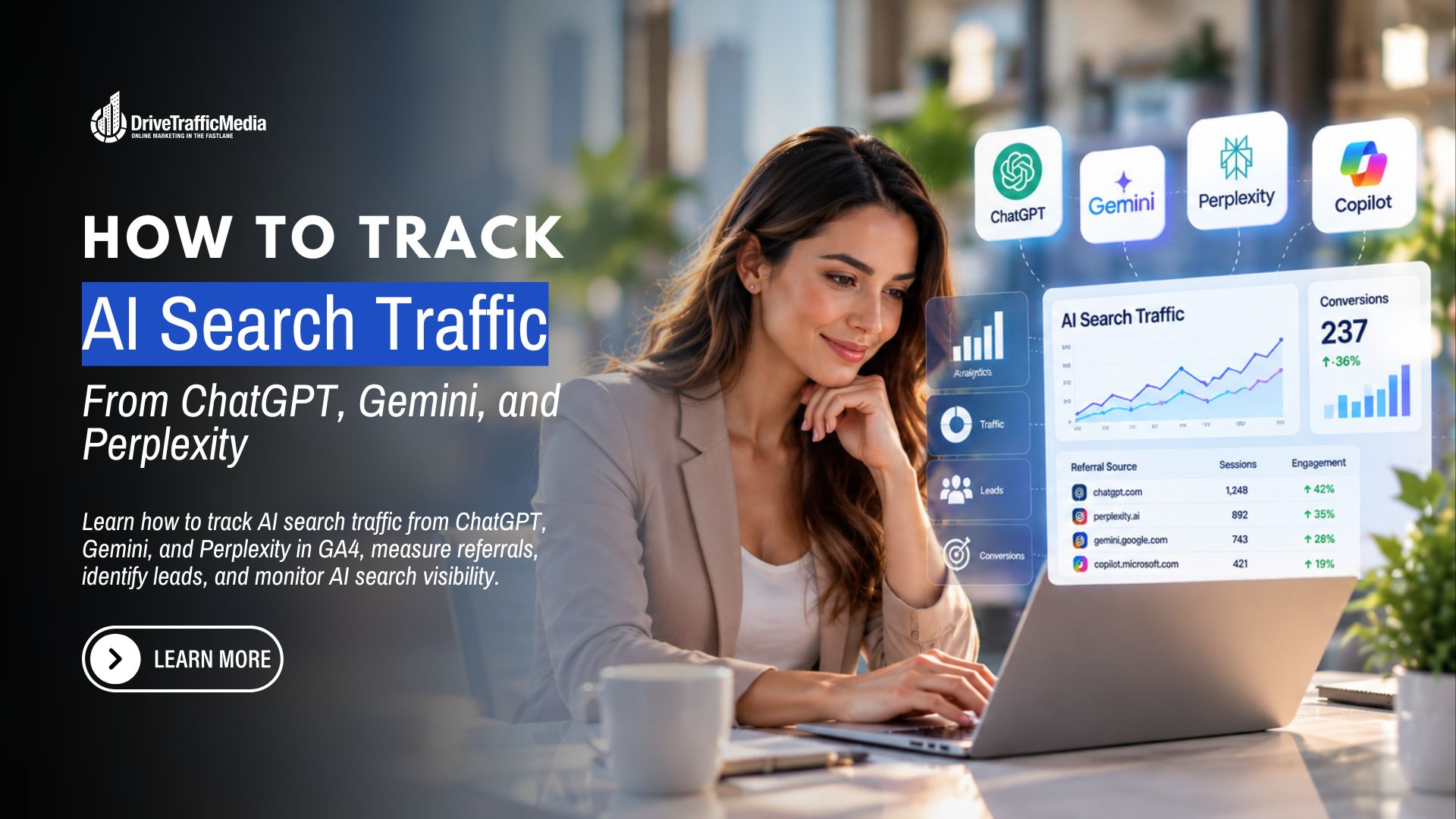
Artificial intelligence is changing how customers discover businesses online. People still search Google, compare websites, read reviews, and explore social media, but they are also asking ChatGPT, Google Gemini, Perplexity, and other AI-powered platforms for recommendations and answers.
For business owners, this creates an important question:
How do you know whether AI search is actually sending customers to your website?
You may be investing in search engine optimization (SEO), Answer Engine Optimization (AEO), and Generative Engine Optimization (GEO). Your content may be appearing in AI-generated responses. Your business might even be recommended when someone asks about services in your area.
But visibility alone does not tell you whether those interactions are producing meaningful results.
That is why AI search traffic tracking is becoming an important part of digital marketing.
Businesses need to understand where visitors originate, which pages attract them, what they do after arriving, and whether those visits generate phone calls, appointments, inquiries, or sales.
At Drive Traffic Media, we believe AI visibility should be evaluated alongside traditional SEO performance, website engagement, and lead generation.
The goal is not simply to appear in AI-generated answers. It is to understand whether that exposure contributes to business growth.
Why Tracking AI Search Traffic Matters
Traditional SEO reporting often focuses on search rankings, organic traffic, impressions, clicks, and conversions.
Those measurements remain valuable.
However, AI-powered discovery introduces additional ways for people to encounter your business.
Imagine someone asks ChatGPT:
“Which commercial cleaning companies serve office buildings in Orange County?”
Another person asks Perplexity:
“What should I look for when hiring a digital marketing agency in Irvine?”
A third person uses Gemini to research website development companies.
An AI platform may summarize information, mention businesses, cite websites, or provide links to relevant resources.
Some users click through to a website. Others use the information without clicking.
This creates two different measurements:
AI search visibility: Whether your business or content appears in AI-generated responses.
AI referral traffic: Whether someone visits your website after following a link from an AI platform.
These measurements are related, but they are not interchangeable.
A business can receive mentions without measurable referral traffic. It can also receive AI referrals without knowing the exact question that caused the visit.
Understanding this distinction is essential to accurate reporting.
What Is AI Search Traffic Tracking?
AI search traffic tracking is the process of identifying website visits that originate from AI-powered search and conversational platforms.
It can include referrals from ChatGPT, Perplexity, Gemini, Microsoft Copilot, Claude, and other services when those platforms pass identifiable referral information.
Businesses can use Google Analytics 4 (GA4) to examine these visits, compare engagement, and evaluate conversions.
The basic objective is to answer four questions:
- Which AI platforms are sending visitors?
- Which website pages are receiving those visitors?
- Are those visitors engaging with the website?
- Are they becoming qualified leads or customers?
For example, a local service company might discover that an educational article receives visits from Perplexity.
Some visitors read the article and leave.
Others continue to a service page.
A smaller number submit a contact form or request an appointment.
Tracking that journey helps the business evaluate whether its content is attracting relevant prospects.
Step 1: Find AI Referral Traffic in Google Analytics 4
Google Analytics 4 is one of the most accessible starting points for measuring identifiable AI referrals.
To begin:
- Open your GA4 property.
- Navigate to Reports → Acquisition → Traffic acquisition.
- Change the report’s primary dimension to Session source / medium.
- Search for or filter sources associated with AI platforms.
- Review sessions, engagement, key events, and other available performance metrics.
Depending on the platform and how the visit was recorded, you may encounter sources such as:
- chatgpt.com
- chat.openai.com
- perplexity.ai
- gemini.google.com
- copilot.microsoft.com
- claude.ai
These are examples of domains worth investigating, not a complete or permanent list.
Some visits may appear under different sources, and others may not carry identifiable referral information.
Google’s traffic-source documentation explains how GA4 uses source and medium information to describe where visitors originate.
Why source and medium matter
The source identifies the referring platform or website.
The medium describes the general traffic category, such as referral, organic search, email, or paid advertising.
A visit from an AI platform may be recorded as referral traffic rather than appearing in a dedicated AI search category.
That means simply checking your Organic Search traffic may not reveal all identifiable AI-driven visits.
Step 2: Create a Custom AI Traffic Channel in GA4
If you want to monitor AI referrals regularly, creating a custom channel group can make reporting easier.
Google Analytics supports custom channel groups that categorize traffic using rules based on source, medium, and other dimensions.
You can create a channel called AI Assistants and define it using relevant source domains.
For example, a source-matching rule could include:
chatgpt.com|chat.openai.com|perplexity.ai|gemini.google.com|copilot.microsoft.com|claude.ai
The precise matching condition depends on the GA4 interface and your property’s observed source values.
How to configure it
- Open GA4 Admin.
- Under Data display, select Channel groups.
- Create a new channel group based on an existing group.
- Add a channel named AI Assistants.
- Configure its source conditions using the domains you want to track.
- Position the channel above broader referral rules where necessary.
- Save the group and use it in acquisition reports or explorations.
Google’s official guide to custom channel groups includes an example specifically for AI assistants.
This gives businesses a more organized way to compare identifiable AI referrals with organic search, paid advertising, social media, and other acquisition channels.
Keep in mind that custom grouping reorganizes recorded traffic. It does not recover referrals that were never identifiable.
Step 3: Identify Which Pages AI Visitors Are Reading
Knowing that ChatGPT or Perplexity sends visitors is useful.
Knowing which pages attract those visitors is even more valuable.
For example, you may discover that AI referrals frequently land on:
- Detailed service explanations
- Educational blog articles
- Frequently asked question pages
- Product comparison guides
- Local service pages
- Original research or case studies
These patterns can help identify content that attracts visitors from AI-powered platforms.
In GA4, use an Exploration to examine landing pages while filtering for the AI referral sources or custom channel group.
Look at sessions, engagement, and conversions for each landing page.
Then evaluate what makes those pages useful.
Do they answer specific questions?
Do they explain a service clearly?
Do they contain original information?
Do they provide detailed examples?
Are they easy to navigate?
This analysis can help inform future content development.
However, receiving AI referrals does not prove that a particular formatting technique caused an AI platform to recommend the page.
Use the data to identify opportunities, not to assume a direct ranking formula.
Step 4: Track Whether AI Visitors Become Leads
Traffic is only one part of the marketing picture.
A business might receive 100 visitors from AI platforms and generate no inquiries.
Another might receive 20 visitors and generate several qualified consultations.
The second result could be more valuable, depending on the quality and value of those leads.
This is why conversion tracking matters.
Useful events may include:
- Successful contact-form submissions
- Appointment bookings
- Consultation requests
- Qualified phone calls
- Purchases
- Proposal requests
GA4 can measure configured key events, while CRM and call-tracking systems can help connect online activity with actual sales opportunities.
A phone-number click should not automatically be treated as a completed phone call, and a form submission should not automatically be treated as a qualified customer.
For a deeper explanation of this distinction, read our article on why your website gets traffic but no phone calls or leads.
An example of AI referral performance
Imagine a company records the following results during one month:
| Traffic source | Sessions | Qualified leads |
| Google Organic | 1,500 | 30 |
| ChatGPT referrals | 85 | 5 |
| Perplexity referrals | 40 | 2 |
| Social media | 600 | 6 |
These figures are hypothetical and illustrate how a business could compare channels.
Although AI referrals account for fewer sessions, they may still contribute meaningful leads.
The company should evaluate lead quality, appointment rates, sales outcomes, and revenue before deciding which channels are most valuable.
Step 5: Understand What Google Search Console Can and Cannot Tell You
Google Search Console remains essential for understanding Google Search visibility.
It can show search queries, impressions, clicks, average position, and performance for individual pages.
However, it does not provide a complete breakdown of referrals from independent platforms such as ChatGPT or Perplexity.
It also should not be treated as a comprehensive report of every time your business appears in an AI-generated answer.
Google Search Console and GA4 serve different purposes.
Search Console helps businesses understand their performance in Google Search.
GA4 helps analyze recorded website visits and visitor behavior across acquisition sources.
Using them together provides a more complete picture than relying on either tool alone.
Drive Traffic Media explains the importance of combining these tools in our guide to integrating Google Analytics and Google Search Console.
Step 6: Track AI Brand Mentions Separately From Website Visits
One of the biggest limitations of referral analytics is that AI platforms can mention a business without generating a website visit.
Someone may ask an AI assistant for local recommendations, read the response, and contact a business later through another channel.
Another person may search the company name on Google after encountering it in an AI answer.
In those situations, the original AI interaction may not be visible in your referral reports.
That is why AI visibility monitoring should be treated as a separate activity.
A business can develop a consistent set of questions related to its services and market.
For example:
“Which companies offer SEO services in Orange County?”
“What should I look for when choosing a web design agency?”
“Which businesses provide commercial cleaning marketing services?”
These questions can be tested periodically across relevant AI platforms.
Record whether the company appears, how it is described, whether the information is accurate, and which sources are cited.
The results should be interpreted carefully because AI responses can vary by platform, wording, location, personalization, and time.
A single response does not establish a reliable visibility trend.
For additional context, our article on how ChatGPT chooses which businesses to recommend explains why businesses need to think beyond traditional rankings.
Step 7: Connect AI Search Tracking With SEO, AEO, and GEO
AI search tracking becomes more valuable when it informs your broader marketing strategy.
Traditional search engine optimization helps make website content discoverable and relevant.
Answer Engine Optimization encourages businesses to organize information around the questions customers ask.
Generative Engine Optimization focuses on improving how business information may be understood, represented, and referenced by AI-driven discovery systems.
These approaches share important fundamentals.
Websites need accurate information, useful content, clear structure, relevant expertise, and strong technical performance.
Businesses also benefit from consistent branding, authentic reviews, and credible information across relevant platforms.
The objective should not be to create content solely for an AI algorithm.
It should be to make the business easier for real customers to understand and evaluate.
Our article on GEO Orange County, SEO, AEO, and LLM visibility provides additional background on how these strategies connect.
Step 8: Build an AI Search Performance Report
Businesses do not need an overly complicated dashboard to begin measuring AI-driven discovery.
A practical monthly report can include identifiable AI referral sessions, top landing pages, engaged sessions, key events, qualified leads, and changes from previous reporting periods.
It can also include a separate section for observed AI brand mentions.
The important part is keeping different measurements clearly labeled.
For example:
AI referral traffic: Visits with identifiable AI-platform sources.
AI referral leads: Inquiries or other conversions attributed to those visits.
AI brand visibility: Observed appearances in AI-generated responses during a defined testing process.
Traditional organic performance: Google Search traffic, search visibility, and associated conversions.
These categories help avoid overstating results.
A business should not claim that every branded Google search came from AI exposure or that every AI mention generated a customer.
Reliable reporting distinguishes measurable activity from possible influence.
Common Mistakes Businesses Make When Measuring AI Search
One mistake is assuming that all AI-driven visitors appear in a single GA4 channel.
Another is assuming that a lack of identifiable referrals means the business has no AI visibility.
Some companies also focus heavily on whether they appear in ChatGPT while overlooking what happens after someone visits their website.
Others count every AI mention as a successful marketing result without considering accuracy, relevance, or customer interest.
The better approach is to measure multiple aspects of performance.
Monitor identifiable traffic.
Track meaningful conversions.
Review landing-page quality.
Evaluate brand visibility separately.
Compare results over time.
And use the findings to improve your website and broader marketing strategy.
How Drive Traffic Media Helps Businesses Adapt to AI Search
Drive Traffic Media helps businesses throughout Orange County and Southern California improve their online visibility through SEO, website development, content marketing, AEO, and broader digital marketing strategies.
As AI-powered discovery becomes part of the customer journey, businesses need to understand both how they are being found and whether that visibility produces meaningful results.
This begins with a strong website, accurate analytics, useful content, and clearly defined conversion goals.
From there, businesses can evaluate AI referral traffic, monitor relevant search performance, improve important landing pages, and identify opportunities to strengthen their digital presence.
The goal is not to chase every new AI trend.
It is to connect emerging search behavior with measurable marketing performance.
The Future of GEO Requires Better Measurement
Artificial intelligence is creating new opportunities for businesses to be discovered.
But the value of those opportunities cannot be judged by mentions or impressions alone.
Business owners need to know whether AI-powered platforms are sending relevant visitors, whether those visitors engage with their websites, and whether the resulting inquiries contribute to revenue.
AI search traffic tracking helps connect GEO and AEO efforts with real business outcomes.
Google Analytics 4, Google Search Console, conversion tracking, CRM systems, and consistent AI visibility monitoring can work together to provide a more complete picture.
As search continues to evolve, businesses that understand their data will be better positioned to improve their content, allocate marketing resources, and respond to changing customer behavior.
If your company wants to improve its search visibility and better understand how AI-driven discovery fits into its digital marketing strategy, explore Drive Traffic Media’s SEO services and AEO optimization services.
The future of search isn’t just about being mentioned.
It’s about understanding what that visibility means for your business.